
Uganda’s Oxygen Advocacy Workshop Makes National Headlines
February 2026 | FREO2 Foundation Advocacy Workshop, Kampala
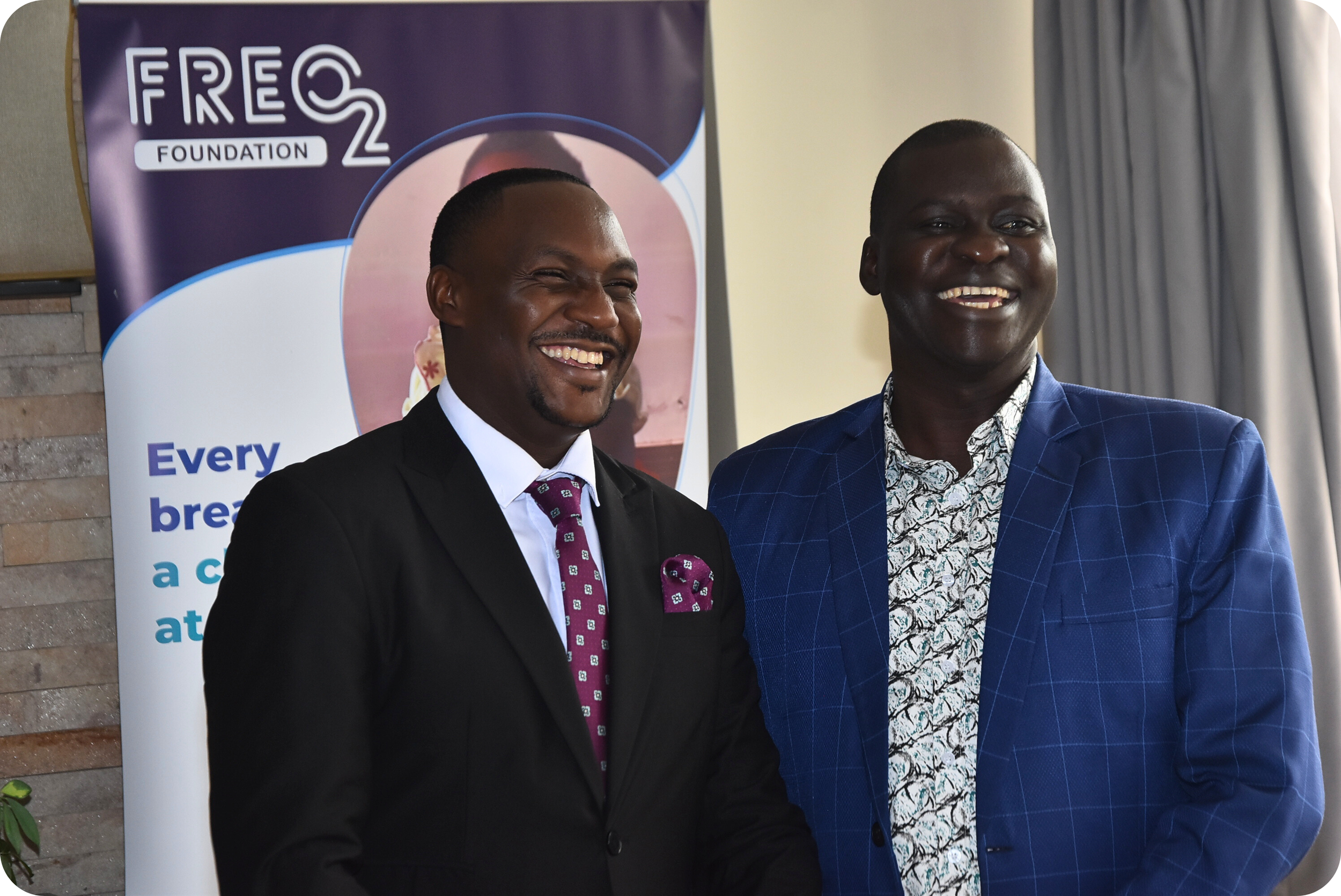
Pictured: Conference moderator, Mr. Brian Mulondo (pictured left), shares a light moment with Dr. John Obungoloch (pictured right), Dean of the Faculty of Applied Sciences at Mbarara University of Science and Technology and a biomedical engineer, during the Oxygen Stakeholder Conference.
Advocacy works when it breaks through. On 19 February 2026, FREO2 Foundation convened a high-level advocacy workshop in Kampala, and within 24 hours, the story was everywhere. Daily Monitor, New Vision, Nile Post, SoftPower News, and Chimp Reports all ran coverage. NTV Uganda's Health Focus programme featured FREO2's life-saving technology in a dedicated television segment. National radio carried the message. Print media picked it up. The call for government investment in medical oxygen at Uganda’s lower-level health facilities had moved from a conference room to the national conversation. For our Grand Challenges Canada programme, this is what strategic advocacy looks like: a single, well-convened event that generates the kind of public and political momentum that accelerates change.
An Advocacy Workshop Designed to Drive Policy
The Strategic Workshop on Oxygen Technology and Alignment with the National Oxygen Programme was not a routine stakeholder update. It was a deliberate advocacy exercise, bringing together Ministry of Health officials, the Oxygen Management Committee, development partners, facility representatives, clinicians, academics, and, critically, the media. FREO2 designed the event to put the right voices in the same room and give them a platform that would carry beyond those walls. It worked.
The media coverage that followed amplified testimony that carries real weight with policymakers and the public. Clinical Services Commissioner Dr Rony Bahatungire announced plans to make piped oxygen systems mandatory at Health Centre IIIs and IIs, the facilities where 80 per cent of Uganda’s mothers give birth. His words, reported across multiple outlets, set out an unambiguous direction: “We pledged to partner with FREO2 to improve access to oxygen across Uganda.” Health Services Director General Dr Charles Olaro was equally direct: “Oxygen has no substitute. If oxygen is only available at the referral hospital, children arrive already damaged from hypoxaemia.”
These are not statements made in private. They are on the record, in the national press, on the radio. That accountability matters enormously for FREO2’s sustainability strategy.
The Evidence That Gave the Advocacy Its Force
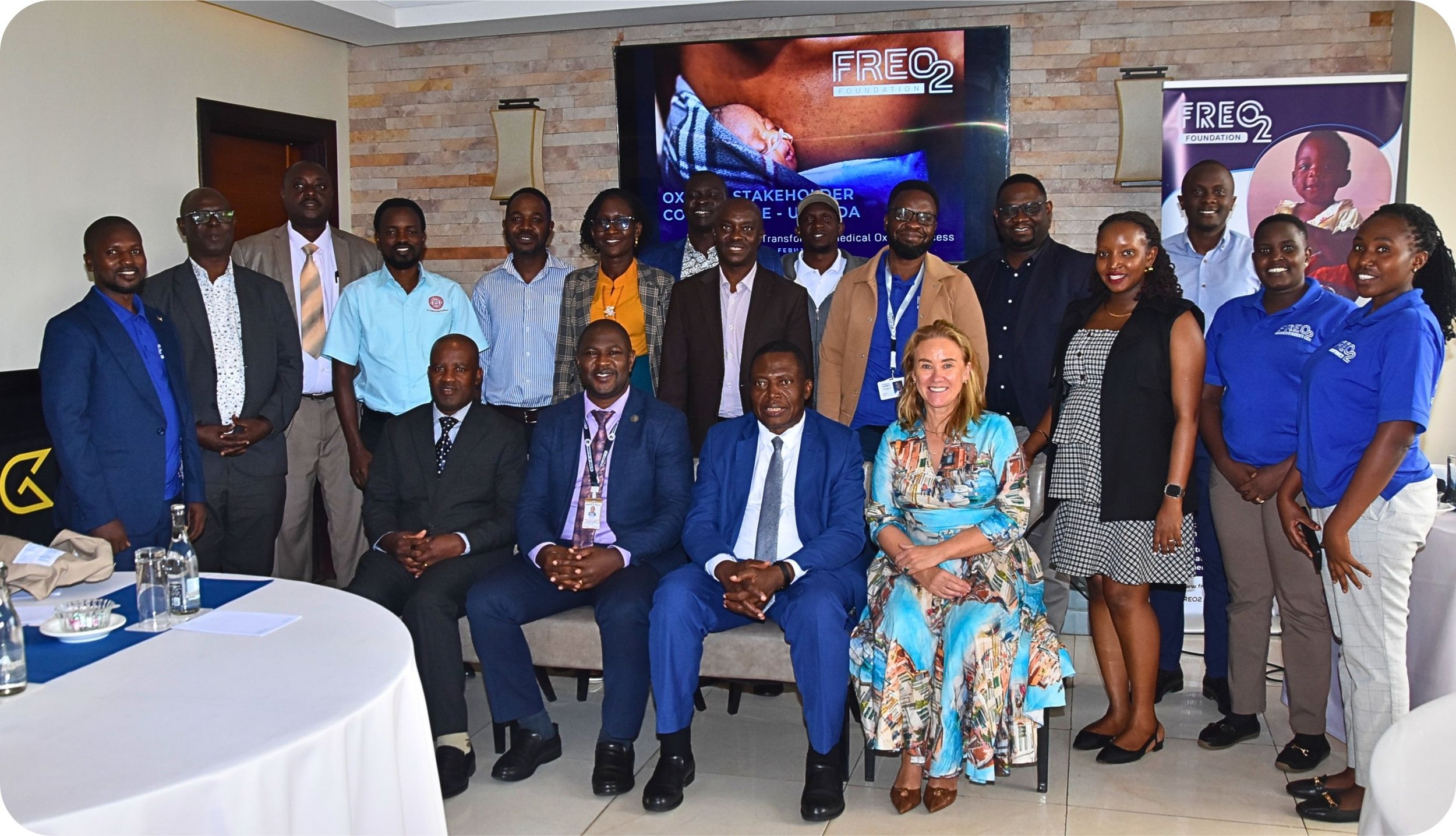
Pictured: FREO2 Foundation CEO Maire Ruane and Team with Oxygen Stakeholder Conference Hosts and Attendees.
Effective advocacy needs more than goodwill, it needs evidence. FREO2 brought both to Kampala. Since 2018, FREO2 has installed 98 oxygen systems across 79 health facilities in Uganda. Thirty-five facilities are now connected to real-time remote monitoring, allowing the team to track oxygen purity, power stability, and cylinder pressure from anywhere in the country. Twenty-two facilities have solarised infrastructure ensuring supply continues when the grid does not. In the past year, nearly 20,000 children in Uganda received oxygen therapy through FREO2-supported systems. Globally, across our full programme, that figure reached 34,789 children.
This is the evidence base that gives FREO2’s advocacy its credibility. The workshop put those numbers alongside the human stories: the twin preterm babies stabilised at Chivale General Hospital using the FREO2 system before transitioning to CPAP; the district health officers saved during COVID-19 by oxygen therapy when they were saturating at critically low levels. Dr Bahizi Archbald Newton Sebahire, Director of Fort Portal Regional Referral Hospital, told that story at the workshop, and it was the kind of testimony that stays with journalists, officials, and audiences long after a press release is forgotten.
Technology Demonstrated, Not Just Described
One of the most effective moments in the advocacy workshop was a live demonstration by FREO2 Uganda’s Biomedical Engineer Hilda Bugingo. Rather than presenting slides, she showed journalists and officials exactly how the system works at the bedside: dual oxygen sources with automatic failover during power outages, real-time remote monitoring of purity and pressure, and direct clinical control for health workers. This is the kind of transparency that builds trust, and it translated directly into the quality of media coverage that followed. Journalists who have seen a technology work are far more compelling advocates than those who have only been briefed on it.
From the Conference Room to the Bedside
The day after the workshop, FREO2 travelled with Ministry of Health officials and journalists to Mpigi Health Centre IV, and the visit made everything concrete. There, in a working facility, the delegation saw the FREO2 system doing exactly what it was designed to do: delivering oxygen to two babies in real time. For the journalists who had covered the workshop, this was the story made visible. For the Ministry officials, it was the evidence they could take back to their own teams. No slides, no projections, just a system quietly keeping two small lives stable. That image is more powerful than any data point, and it is the kind of moment that turns policy interest into policy commitment.
From Headlines to Roadmap: What Comes Next
Advocacy is not an end in itself. The workshop concluded with a commitment to develop a short, actionable roadmap covering oxygen data integration into national health systems, clinical training expansion, biomedical engineering recruitment, and dedicated government budget lines for facility-level oxygen infrastructure. These are the structures that will determine whether Uganda’s oxygen commitments outlast any single programme or funding cycle.
For the Grand Challenges Canada programme, this is a pivotal indicator. When senior government officials make public commitments in front of national media, when those commitments are tied to specific policy changes, and when there is a roadmap for turning commitments into budget lines, the transition from donor-supported innovation to government-owned system is no longer theoretical. It is underway.
A Right, Not a Privilege Said Loudly, and in Public
Globally, an estimated 1.6 million child deaths each year are linked to lack of oxygen access, with 80 per cent occurring in peripheral, low-resource settings. Uganda is demonstrating that this does not have to be the story. As FREO2 CEO Máire Ruane said at the workshop: “If we can get oxygen into children’s lungs at the right time without waiting for referral, we can save at least 30 per cent of those lives.”
That statement was made in a room full of journalists. It appeared in the national press. It was broadcast on NTV Uganda's Health Focus and on the radio. That is what advocacy that achieves reach looks like, and it is the foundation on which Uganda’s oxygen future is being built.
“Every child has the right to breathe, live, and thrive. Uganda is saying so, loudly, and on the record.”
Media coverage of the advocacy workshop:
• NTV Uganda Health Focus: New oxygen device in Uganda saves 1,000 newborn lives
• Daily Monitor: Govt urged to prioritise oxygen plant funding to save lives
• Chimp Reports: Experts push for expanded oxygen access in national alignment talks
• Nile Post: Oxygen access at Health Centre IIIs takes centre stage at FREO2 stakeholder conference
• SoftPower News: FREO2 Foundation hosts strategic workshop to strengthen oxygen access in Uganda
• New Vision: Govt says to upscale oxygen supply to lower health centres
